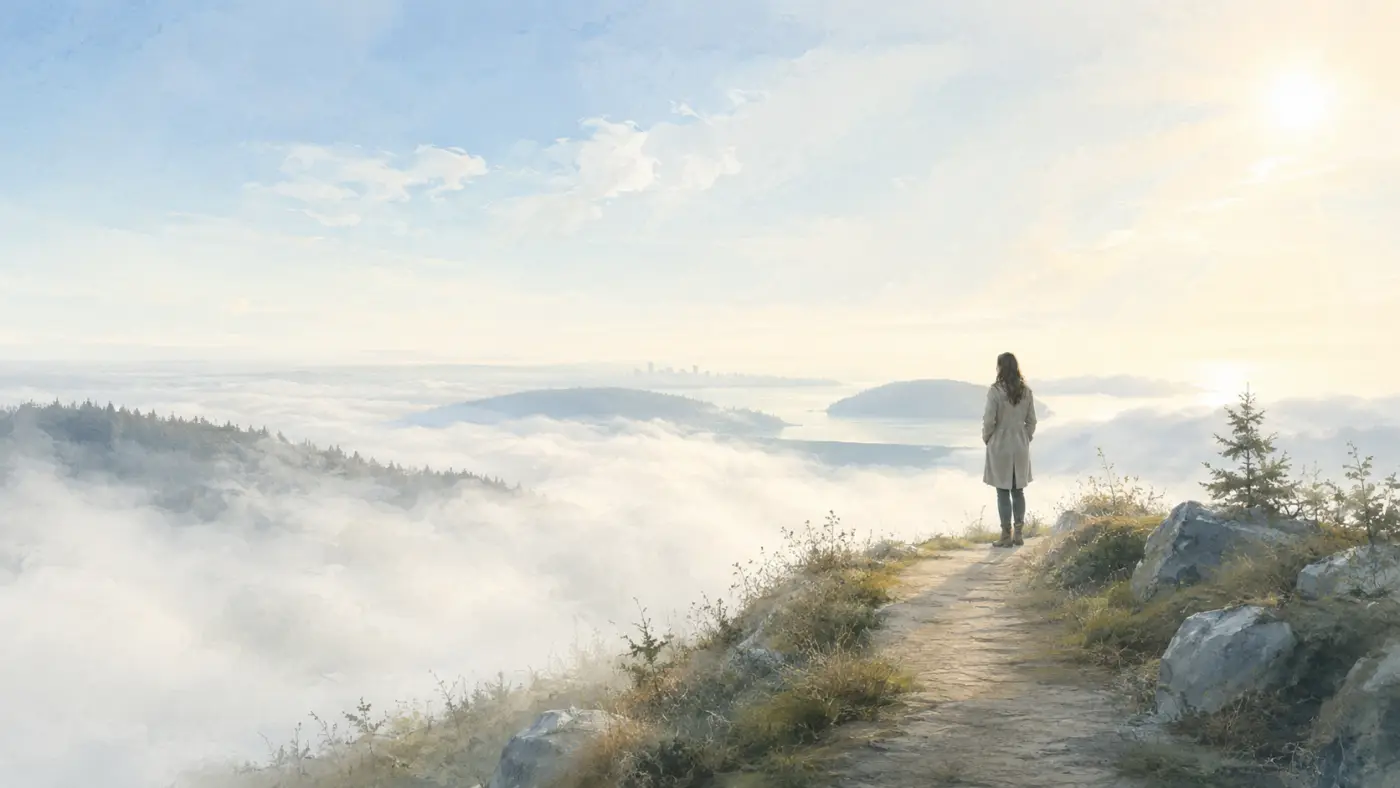
The sun came out. I feel so much joy. The sun came out because the fog had slightly lifted. Fog has its own life, its own rhythm, and its own direction.
A few days ago, earlier last week, I happily noticed that the sun was shining outside my window and the sky was clear, blue, and incredibly high. It felt like a small miracle and a rare occurrence for January in Metro Vancouver. Days like this feel worth celebrating, because you want to go for a walk, breathe in the space, and catch the light. I checked the weather forecast and was surprised to see that the next five or six days promised clear skies. My joy felt limitless, and I was already making plans in my mind.
The next day, everything changed. There was fog outside the window. And the day after that, again. It stayed for four days in a row.
Usually, the weather in Richmond is sunnier, warmer, and less rainy than in many other parts of Metro Vancouver. But Richmond is partially located below sea level. The city is built on the delta of the Fraser River, mostly on Lulu Island. A significant part of the area lies one to two meters below sea level, and the landscape here is flat compared to the surrounding areas.
On Sunday, on the second or third day of dense fog, we decided to drive toward the ocean. It turned out that there was no fog at a higher elevation. Just a few kilometers and a little more height, and the air was already clear, making the space open and visible.
As an art therapist, I feel deeply connected to metaphorical language, because it allows us to say much more than direct words ever could. It is safe, it does not demand immediate answers, and it does not intrude directly into painful places. Metaphor creates a space where a person can approach their experience at their own pace, choosing a distance that feels manageable in the moment. It allows us to speak about difficult things through indirect paths, without naming them outright, and still feel heard.
In metaphorical language, there is permission for uncertainty, for multiple meanings, and for different layers of understanding. It does not impose meaning but rather invites it. That is why metaphor often heals not through explanation, but through recognition, when something inside quietly resonates and finds words without force.
At the same time, I deeply value clarity, honesty, analysis, and a systemic way of seeing. I know how to ask questions in a way that even through metaphor we can arrive at understanding painful themes.
In my youth, I lacked this greatly. In some areas of my life, I truly lived in fog. I did not know how to ask questions that could help the fog clear, even though intuitively I sensed that something was not right. I lacked not only knowledge about "coaching questions," but often, I lacked the courage to ask them. It felt as though "uncomfortable questions" might hurt someone or put them in an awkward position. I sacrificed my own comfort so that others could feel comfortable around me. I reduced myself to a convenient version, and I crossed out entire parts of my identity, especially in personal relationships and within my family. I lived in fog to avoid confrontation.
That was not all of me.
Fog is an inner space where you do not need to know in advance. It is a state in which clarity temporarily steps back so the psyche can rest from decisions, expectations, and the demand to be understood. In fog, it is allowed not to see far ahead, but to move step by step, trusting bodily sensations and quiet impulses.
But when fog in relationships becomes chronic through manipulation, unspoken dynamics, and blurred boundaries, sometimes it is important to look away from the fog and rise a little higher to gain clarity. It helps to see the broader context and to name things as they are.
My favorite colors are white and light blue. I love clarity, transparency, and honesty. Human dignity has been and remains one of my core values.
In my therapeutic work, I follow the principle that the client is the expert of their own life. I simply walk alongside them. I help illuminate strengths and resources, and gently look at shadow parts, including those that once seemed unworthy of attention or carried shame. Often, that is where resources are hidden, resources that cannot be accessed because someone once made it clear that "this is wrong," or that "good girls" or "good boys" do not do this.
In the space with me, you are allowed to be yourself. You are allowed to feel safe, to restore your resources, and to look even where it once felt frightening to look. And gradually, you can expand the space for yourself and for your life.